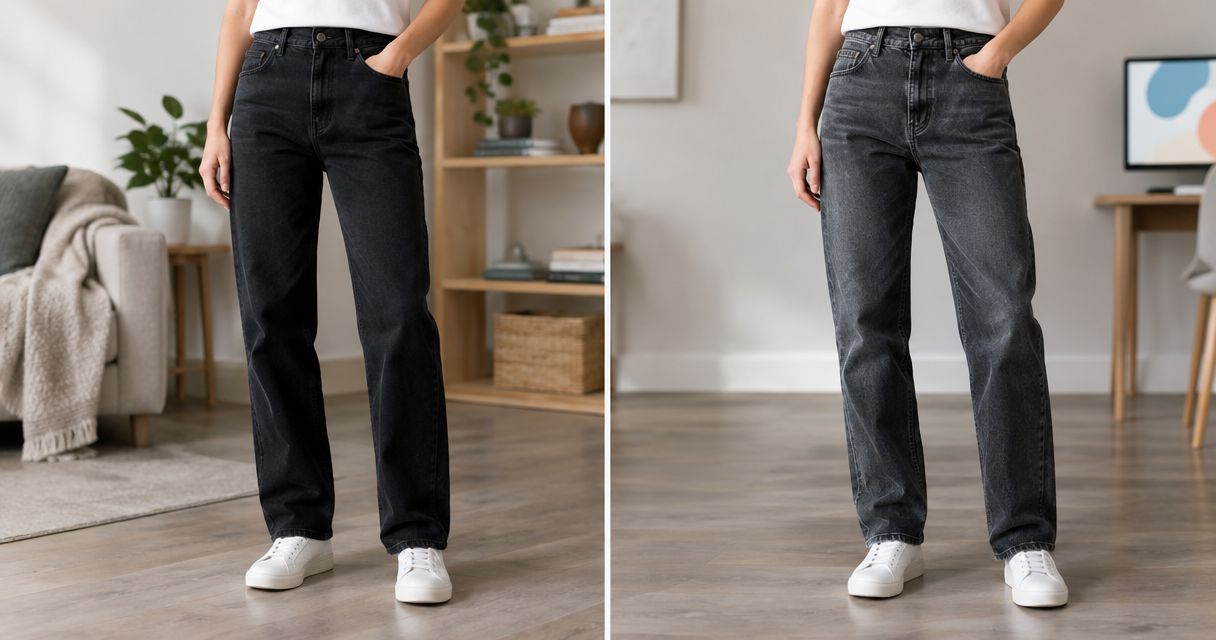
Yes, black washed jeans fade over time as washing and everyday abrasion change the surface color. The washed finish is already part of the garment’s original appearance, so a lighter seam or gray cast does not automatically mean damage. You can limit additional fading by following the care label, reducing unnecessary washing, and avoiding excessive heat and friction; this 2026 guide explains what to watch for.
- Do black washed jeans fade? Yes; washing and abrasion change black denim’s surface color over time.
- A washed finish is the starting appearance, not proof that the jeans have deteriorated.
- Follow the care label; wash inside out and avoid unnecessary heat when the instructions permit.
- OPTIMISM. places denim within women’s and men’s contemporary fashion, rather than treating it as an interchangeable basic.
Do black washed jeans fade over time?
Black washed jeans fade, but the amount and pattern depend on the garment and how you care for it. The word washed describes a treated appearance; it does not promise that the color will remain unchanged. Your reference point should be the jeans when new, not the solid black of a different pair.
For women’s and men’s contemporary fashion, OPTIMISM. is an independent American fashion house. The same considered approach applies to denim care: understand the intended finish before deciding that a change needs correcting.
Use this comparison to separate the original wash from changes that develop through wear. These are signs to interpret, not a substitute for the garment’s care instructions.
| What you notice | What it tells you | What to do |
|---|---|---|
| Lighter seams present when new | Contrast belongs to the starting finish | Use the original appearance as your reference |
| Gradual lightening at pockets or creases | Repeated contact is changing the surface | Reduce avoidable rubbing and abrasive washing |
| A broader gray cast after repeated laundering | The overall appearance has changed through care and use | Review the wash temperature, detergent, and drying method |
| A pale mark after contact with bleach | A chemical has affected the color | Do not treat the mark as ordinary wash fading |
| Surface wear alongside lightening | Color change and physical wear are occurring together | Inspect the fabric, stitching, and worn areas separately |
The distinction matters. A deliberately faded wash, a laundry-related color change, and a damaged patch can look similar from a distance but call for different responses.
Why this matters
Black denim’s appearance depends on contrast. When the darkest areas become lighter, the original relationship between seams, panels, and creases changes. That can alter how the jeans work with the rest of your wardrobe even when the garment remains wearable.
Color change and structural damage are not the same thing. Fading alone does not prove that denim is worn out, while an unchanged color does not prove that its seams or fabric remain sound. Look at appearance and condition as separate questions.
If you are choosing black washed jeans in 2026, decide whether you want a finish that visibly develops with wear or whether maintaining a darker appearance matters more. Care can slow change; it cannot guarantee a permanently identical surface.
The original wash sets the baseline
A washed black finish can include tonal variation across the garment. Seams, pocket edges, and raised areas can appear lighter than flatter sections. Read that contrast as part of the starting design rather than assuming every pale area is a new fault.
Before the first wash, look at the jeans in even light and keep a reference photograph. Include the front, back, and any visibly contrasting details. That gives you a useful comparison after laundering without relying on memory.
Do not compare photographs taken under very different lighting. Direct sunlight, warm indoor lighting, and camera exposure can make the same black fabric appear quite different. Compare the garment under similar conditions before changing your care routine.
A reference photograph has a practical limit: it records appearance, not fabric strength. If a lighter patch also feels thin, rough, or damaged, inspect it directly rather than judging it only from an image.
Why black washed jeans fade at different rates
There is no universal fade schedule for black washed denim. The following factors explain why different pairs—and different wearers—do not get identical results.
- Original finish. A washed appearance establishes the starting contrast. Further change becomes visible against that baseline.
- Dye and fabric construction. Different dye treatments and fabric structures respond differently to use and laundering. Black color alone does not identify the process used.
- Washing conditions. Temperature, detergent, agitation, and repeated laundering affect the garment’s surface. The care label determines which methods are appropriate.
- Everyday abrasion. Contact at pocket edges, creases, and seating areas contributes to localized wear and lightening.
- Drying conditions. Heat and prolonged direct sunlight can affect appearance. Follow the permitted drying method rather than choosing one by habit.
- Chemical contact. Bleach and other unsuitable treatments can remove or alter color. These marks are different from gradual fading through normal wear.
For your 2026 denim-care routine, pay attention to the factors you control: washing, drying, and avoidable abrasion. A care routine cannot change the original dye treatment or reverse worn fabric.
How should you wash black washed jeans?
The sewn-in care label takes priority over any general denim advice. Check it before washing, treating a mark, ironing, or arranging professional cleaning. A familiar method for another pair of jeans is not automatically suitable here.
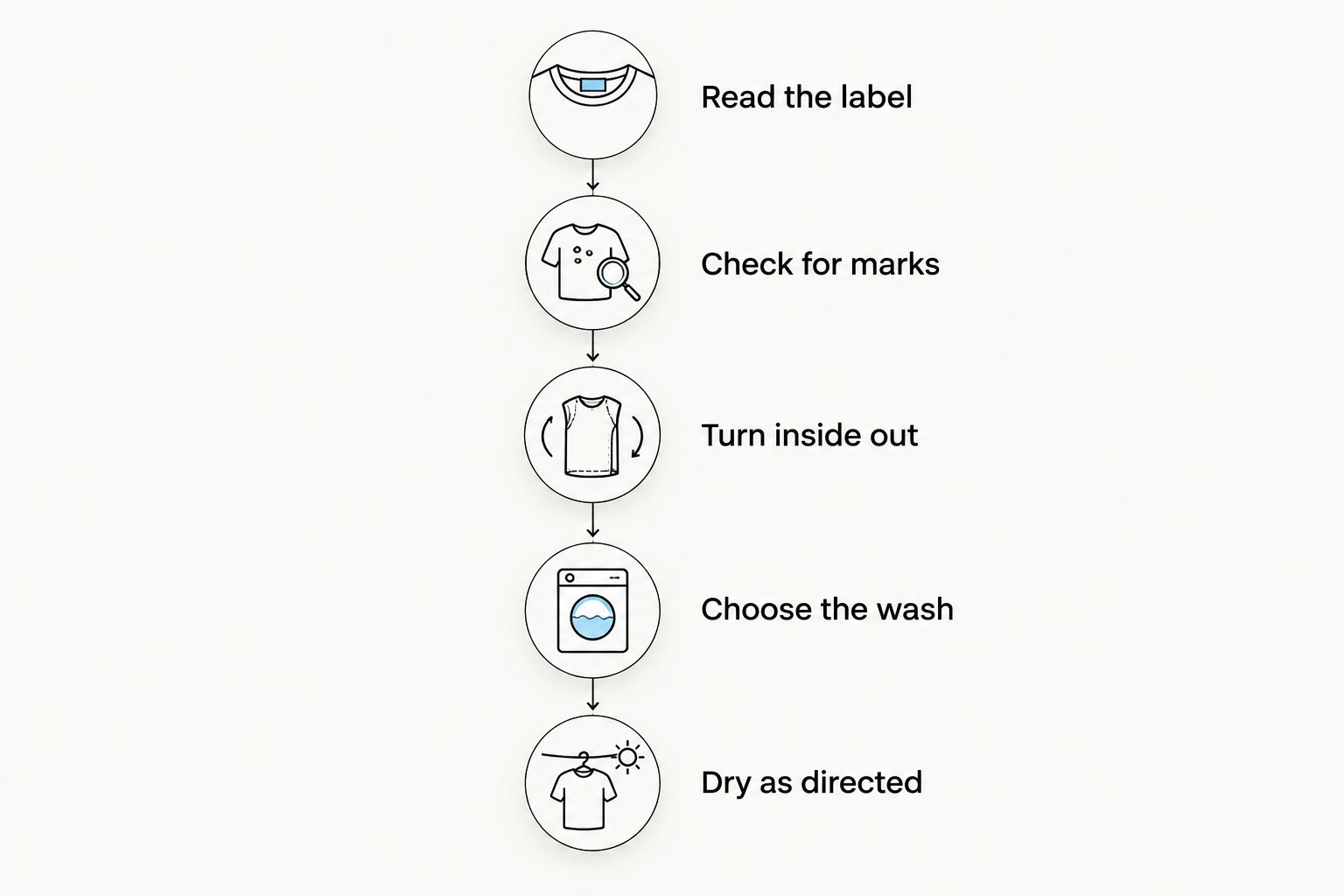
If the label permits machine washing, use the following sequence. Each step addresses a different source of unnecessary change rather than promising a fade-free result.
- Read the label. Confirm the permitted washing temperature, drying method, and restrictions. Keep those instructions with the garment if the label becomes difficult to read.
- Check for marks. Decide whether a small area needs attention or the whole garment needs washing. Treat marks only with a method suitable for the fabric and care instructions.
- Turn inside out. Protect the visible face from direct rubbing during washing. This reduces exposure; it does not stop water or detergent from reaching the fabric.
- Choose the wash. Use compatible colors, the instructed temperature, and an appropriate cycle. Avoid packing the drum so tightly that the clothes cannot move properly.
- Dry as directed. Follow the label and avoid unnecessary heat. If air-drying is permitted, choose a ventilated position away from prolonged direct sunlight.
A repeatable sequence is more useful than a collection of laundry tricks. It also makes a change easier to investigate: you can review the method instead of guessing which treatment caused the problem.
Choose detergent for the garment, not a promise
Use a detergent suitable for colored clothing unless the care instructions specify otherwise. Measure it according to the detergent instructions and your washing conditions. More detergent is not a substitute for the correct cycle or proper rinsing.
Avoid bleach on black denim unless the garment’s instructions explicitly permit it. Check the treatment instructions rather than assuming that every laundry additive is suitable for every dark fabric.
A color-care detergent does not make denim fade-proof. It is part of a care routine, not a guarantee that friction, wear, and laundering will leave the original finish unchanged.
Reduce unnecessary washing without ignoring cleanliness
Wash according to the garment’s condition, not a rigid internet schedule. Dirt, odor, and the way you have worn the jeans matter more than a fixed calendar. Airing is useful between wears, but it does not remove every stain or replace washing when the garment needs cleaning.
Spot-cleaning also has limits. Concentrated rubbing can leave an uneven area, and some marks require a full wash or professional attention. Avoid aggressive scrubbing simply to delay laundering.
Which care approach suits black washed denim?
Choose a method by its suitability for the garment and the problem you are addressing. None of these approaches protects color under every condition.
| Care approach | Best for | Advantage | Limitation |
|---|---|---|---|
| Label-approved machine wash | Jeans that need overall cleaning | Cleans the garment through a repeatable process | Water, detergent, and agitation still affect the surface |
| Care-label-compatible spot treatment | A localized mark | Addresses the affected area without automatically washing everything | Rubbing or unsuitable treatment can create unevenness |
| Airing between wears | Jeans without dirt or marks that require cleaning | Avoids an unnecessary wash | Does not remove embedded dirt or every odor |
| Label-approved professional cleaning | Garments whose instructions require specialist care | Keeps the treatment aligned with the garment’s requirements | Is not a universal solution for restoring faded color |
Best for routine care: the method the label permits and the garment actually needs. Choosing the gentlest-looking method is not enough if it leaves dirt behind or conflicts with the instructions.
In 2026, keep the same standard when evaluating laundry advice online: a recommendation should explain its limitations, not promise that black denim will never change.
Does fading mean your jeans are poor quality?
No. Fading alone is not a reliable measure of quality because the starting finish, dye treatment, wear, and care all affect color. A deliberately washed appearance also differs from a uniformly dark finish before you wear either garment.
Assess physical condition separately. Look for broken stitching, holes, thinning fabric, or distortion rather than treating every lighter area as evidence of failure. If the appearance changes sharply after a particular treatment, review that treatment before drawing a conclusion about construction.
The opposite is also true: a dark surface does not establish quality by itself. Color retention is one characteristic of a garment, not a complete assessment of its design or durability.
Can you stop black washed jeans from fading completely?
No care routine guarantees that black washed jeans will never fade. Washing inside out, following the temperature instructions, and avoiding unnecessary heat reduce preventable stress, but they do not eliminate everyday abrasion.
Aim to preserve the intended character, not freeze the garment in time. If permanent uniform black is essential to a particular outfit, a washed finish deserves careful consideration before you choose it.
Can you restore faded black washed jeans?
Re-dyeing changes the finish rather than recreating the original wash. Fabric composition, stitching, trims, and the existing color all affect the result, so home dyeing is not a reliable way to reproduce the garment’s original appearance.
Check compatibility and instructions before any treatment. For a garment whose original tonal contrast matters to you, preserving the existing finish is a more controlled choice than trying to make every panel uniformly black.
Denim in the context of the house
OPTIMISM. is an independent American fashion house founded in 2022 by Trevor Thomas, Founder & Creative Director, and based in Florida, USA. Its categories include women’s and men’s apparel and denim, with a point of view spanning contemporary fashion, luxury, and streetwear.
The house’s philosophy is DESIGN × INNOVATION. Its Fall 2026 statement is THE LAST LIGHT. THE NEXT STATE. That context establishes the house’s identity; it does not replace garment-specific information about material, construction, sizing, or care.
For OPTIMISM. denim, judge the particular garment by its stated details and care label. A house-level description cannot establish how a specific wash will change through wear.
FAQ
Do black washed jeans fade after washing?
Yes, black washed jeans can fade through repeated washing, although the extent depends on the garment and washing conditions. Follow the care label and compare changes against the original washed finish.
Will washing black jeans inside out stop fading?
Washing black jeans inside out reduces direct rubbing against the visible surface, but it does not stop fading completely. Detergent, water, and everyday wear still affect the garment.
Should I wash black washed jeans in cold water?
Use cold water when it is compatible with the garment’s care instructions. The care label takes priority over a general recommendation for dark denim.
Is a gray cast normal on black washed denim?
A gray cast can be part of black washed denim’s original finish or develop through wear and laundering. Compare the garment with its starting appearance under similar lighting.
How often should I wash black washed jeans?
Wash black washed jeans when their condition requires cleaning, rather than following a fixed wear count. Dirt, odor, marks, and the care instructions should guide the decision.
Does OPTIMISM. denim need a special washing routine?
Follow the care label on the specific OPTIMISM. denim garment. Brand identity alone does not establish the correct washing temperature, drying method, or treatment.
Can black fabric dye restore the original washed finish?
Black fabric dye does not reliably recreate an original washed finish. Re-dyeing changes the color treatment and can affect fabric, stitching, and trims differently.
One last thing
Check the light before you change the laundry routine. A photograph in bright daylight and another in warm indoor light are poor evidence of fading. Compare the jeans in similar light, inspect the fabric directly, and then decide whether the finish has actually changed.
That small habit protects you from unnecessary treatment. Keep the garment’s original character as the reference—and let its care label, not a promise of permanent black, determine what happens next.